Read also
No related articles
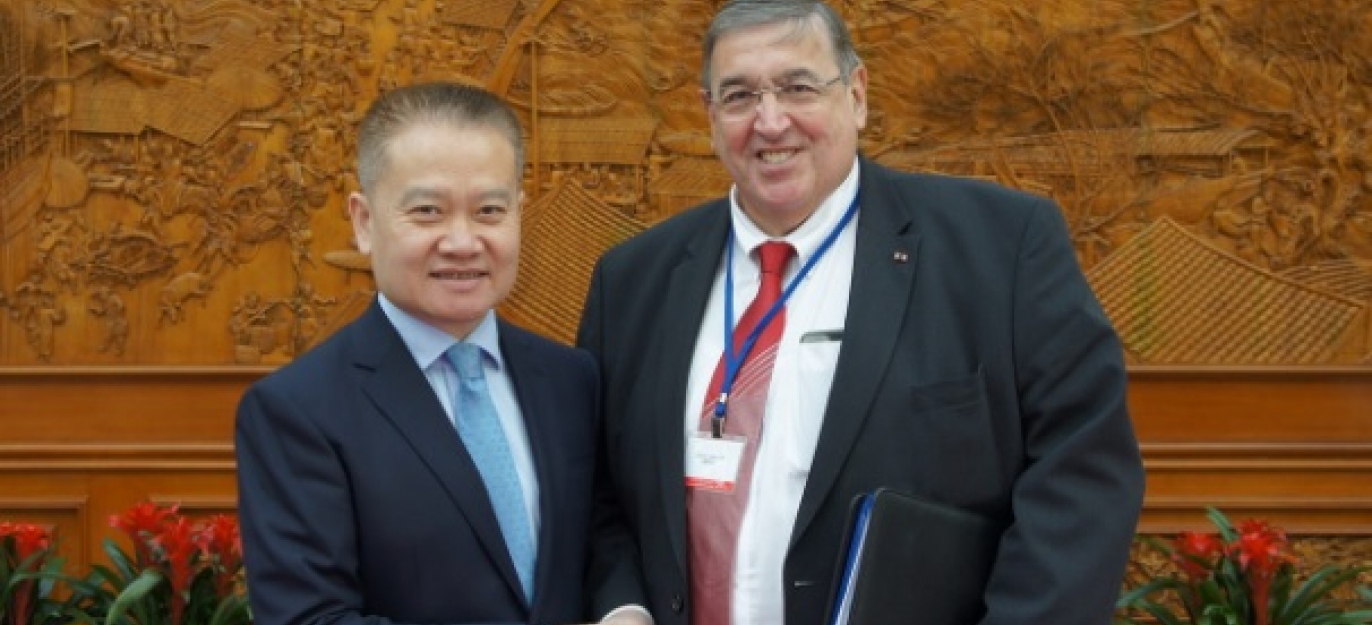
Beijing/Brussels, 9 August 2016 - Senior Chinese officials defended Beijing’s stance over the territorial disputes in the South China Sea and stressed that the People’s Republic of China (PRC) will remain firm over its territorial claims, NATO Parliamentarians were told during a weeklong visit. However, China prefers peaceful resolution and dialogue to solve the issue, according to Luan Jianzhang, Deputy Director, International Department of the Central Committee of the Communist Party of China, and other officials.
The delegation, consisting of 19 members of parliament from 10 NATO member states led by Karl A. Lamers (Germany), visited Beijing and Shanghai during the week of July 25-29, 2016. The purpose of the visit was to learn about China’s foreign policy priorities and the underlying domestic issues driving them, as well as regional security issues. Composed of the Political Committee’s Sub-Committee on NATO Partnerships (PCNP), the delegation engaged in dialogue with senior government and Communist Party officials, as well as non-governmental experts.
Key topics of the meetings were regional security issues, particularly concerning the South China Sea, Chinese perspectives on security cooperation with NATO and "One Belt, One Road," China's extensive programme of infrastructure investment and trade association westward through Asia and Eastern Europe. Other issues that featured on the agenda were China’s interests in the Arctic and its engagement in Africa as well as its increasing international engagement, including in the establishment of the Asian Infrastructure Investment Bank (AIIB).
Both official speakers and independent experts emphasised that China remains committed to creating a peaceful environment in order to continue its development. Beijing emphasises equal partnerships with the world’s major powers, notably with the United States, the delegation learned. Initiatives like the AIIB are not aimed at undermining established international institutions like the World Bank, but created a healthy complement to existing ones and thus generate additional financial resources, including private ones, for development, the delegation heard. Still, the priorities for the Chinese leadership will remain its internal economic development and social and political stability. To that end, the Chinese leadership pursues a policy that aims at sharing and reallocating wealth and continues to put emphasis on the anti-corruption campaign, military reform and economic growth.
The visit took place shortly after the Permanent Court of Arbitration in The Hague ruled against China and in favour of the Philippines, which had challenged some of China’s territorial claims in the South China Sea. China had boycotted the proceedings, arguing that the tribunal had no jurisdiction and that it would ignore any decision. Host country interlocutors acknowledged that the regional security environment is volatile. However, while tensions among several littoral states exist, there is no arms race, they stressed. With regard to the Korean Peninsula, Chinese officials suggested that the best way to address this issue is to pursue a “hybrid dialogue”, i.e. continue the six-party nuclear talks and the bilateral negotiations between the Republic of Korea (ROK) and the Democratic People’s Republic Korea (DPRK) simultaneously. However, Official Chinese interlocutors repeatedly warned that the deployment by the United States of the THAAD missile defence system on the territory of the ROK would affect the security of the PRC negatively. Senior Colonel Zhou Bo, Office of International Military Cooperation, Ministry of Defence, suggested that the threat posed by the DPRK’s nuclear programme would not warrant deployment of the system which would have a negative impact on regional stability.
Host country speakers repeatedly inquired about the impact of Brexit on Europe, and Europe’s relations with China. They expressed the hope that the EU will not become protectionist as a result of the outcome of the UK referendum to leave the EU. China is also concerned about the threat posed by Daesh, and the instability in the Middle East and North Africa (MENA) region, the delegation learned. However, while the PRC and NATO member states share an interest in the defeat of Daesh, practical cooperation remains unlikely for the time being. On Syria, the PRC will continue its policy of non-interference according to Liu Haixing, Assistant Minister of Foreign Affairs. More generally, host country officials and analysts commented that contacts between China and NATO are welcome and should be expanded where possible, but also noted that relations remain hampered by the mixed perception of the Alliance in China. Chinese speakers and members of the delegation agreed that continued and increased dialogue is desirable in order to improve mutual understanding.
No related articles