Read also
No related articles
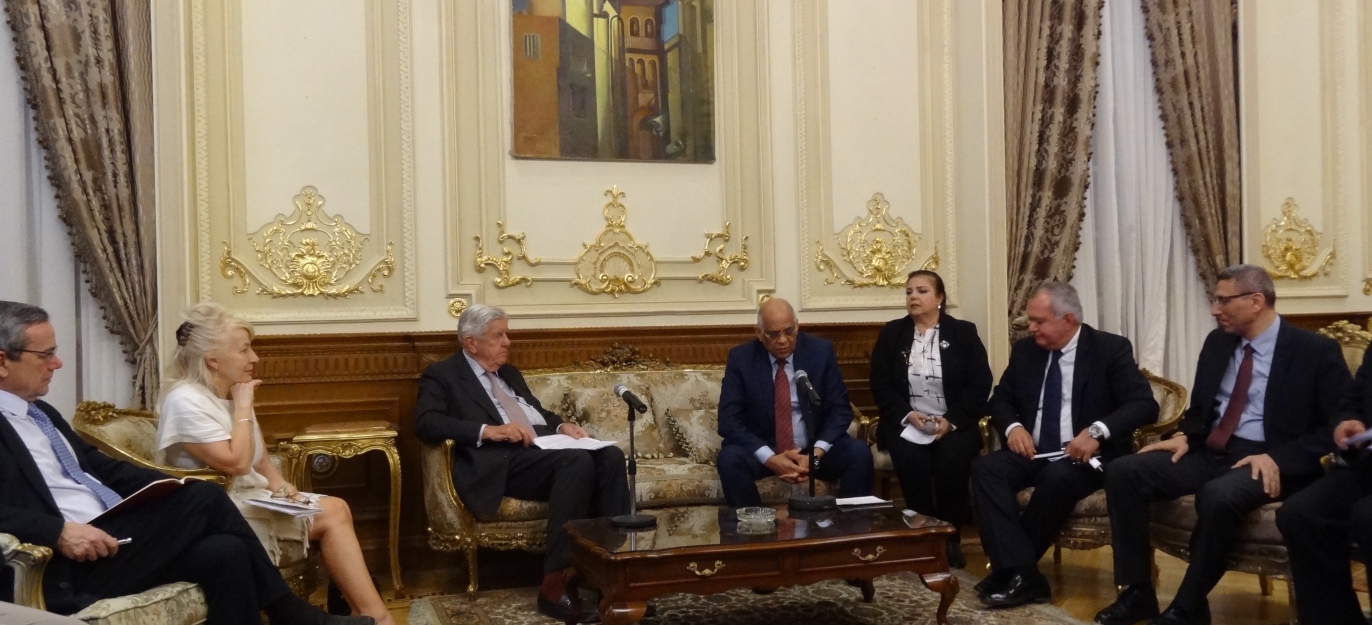
Cairo/Brussels, 8 April 2016 - Egyptian authorities feel that their country’s contribution to the fight against Daesh does not receive sufficient international recognition or support, members of the NATO Parliamentary Assembly’s Bureau were told during their visit to Cairo on 5-6 April.
Egyptian officials urged NATO governments to enhance efforts to stem the flow of Daesh supporters from Syria and increase the sharing of intelligence. Most importantly, they stressed the urgency of stabilising the situation in Libya. Ongoing instability there, and the relative ease with which Daesh fighters move between Libya and Syria, affect the security of the entire region and beyond, Egyptian officials warned.
President Abdel Fattah al-Sissi emphasised that it is important “to stand shoulder-to-shoulder in the fight against violent extremists”, and implement a comprehensive strategy that includes “military, political, economic, social, and cultural components”. He stressed the need for a strong Libyan army that could provide security for Libya and help re-unify the country. “NATO has not finished its mission in Libya”, he argued, suggesting that NATO nations support the Libyan army by sharing intelligence and by providing equipment and training. President al-Sissi assured the delegation that Egypt was willing to contribute to NATO efforts to stabilise the country. However, he cautioned against a NATO troop presence on the ground in Libya, which in his view would draw Daesh further in, and complicate the situation.
President al-Sissi and indeed all the Egyptian representatives who met the delegation stressed Egypt’s interest in strengthening cooperation with NATO Allies. To that end, fostering mutual understanding and an atmosphere of partnership was crucial.
While international cooperation was seen as essential in dealing with the roots of terrorism, Egyptian officials noted that the country was able to tackle the challenge to its own security, including ongoing tensions in the Sinai. They regretted what they saw as an exaggerated coverage by international media of the terrorist threat within Egypt – a perception that had hit the country’s tourist industry hard.
Egypt indeed faces several difficult economic challenges. Its population of some 90 million increases by approximately 2.5 million each year, a demographic growth which its economy struggles to leverage. A recurrent theme in the meetings was therefore the desire to see more foreign investment.
Discussions with the Speaker of the Egyptian House of Representatives, H.E. Mr Ali Abdel Aal,and Members of the House, focused on the role of the recently elected Egyptian Parliament in implementing reforms, as well as possible future avenues for strengthening cooperation with the NATO Parliamentary Assembly. Egyptian parliamentarians acknowledged the need for progress in areas such as the rule of law and human rights, and asked for patience and understanding. The new parliament was seeking to implement social, economic, judicial, police, education, and health reforms, some of which were very ambitious in scope. In this way, it was “paving the way for real democracy”, the Speaker noted.
In view of increasing international concern about disappearances, and asked about the specific case of murdered Italian student Guilio Regeni, President al-Sissi assured the delegation that Egypt will fully cooperate with Italian investigators and do all it can to resolve this issue which had cast a cloud over relations between Egypt and Italy as well as other countries.
During their visit to Cairo, the NATO PA delegation met with the President of the Arab Republic of Egypt, H.E. Mr Abdel Fattah al-Sissi; the Speaker of the Egyptian House of Representatives, H.E.Ali Abdel Aal; , the Minister of Foreign Affairs, MrSameh Hassan Shoukry; and the Minister of Defence, Colonel General Sedki Sobhi Sayyid Ahmed.
Discussions were also held with a large delegation of Members of the Egyptian Parliament, and representatives of several Allied diplomatic missions.
The NATO PA delegation consisted of Vice Presidents Lord Jopling (United Kingdom) and Paolo Alli (Italy); Treasurer Marc Angel (Luxembourg), Former Vice Presidents Nicole Ameline (France), and Cheryl Gallant (Canada); Secretary General David Hobbs; and Director of the Political Committee, Steffen Sachs.
The Egyptian parliament participates in the NATO Parliamentary Assembly with the status of parliamentary observer. However, this was the first visit of a NATO PA delegation to the country since the uprising against former President Hosni Mubarak in 2011.
No related articles