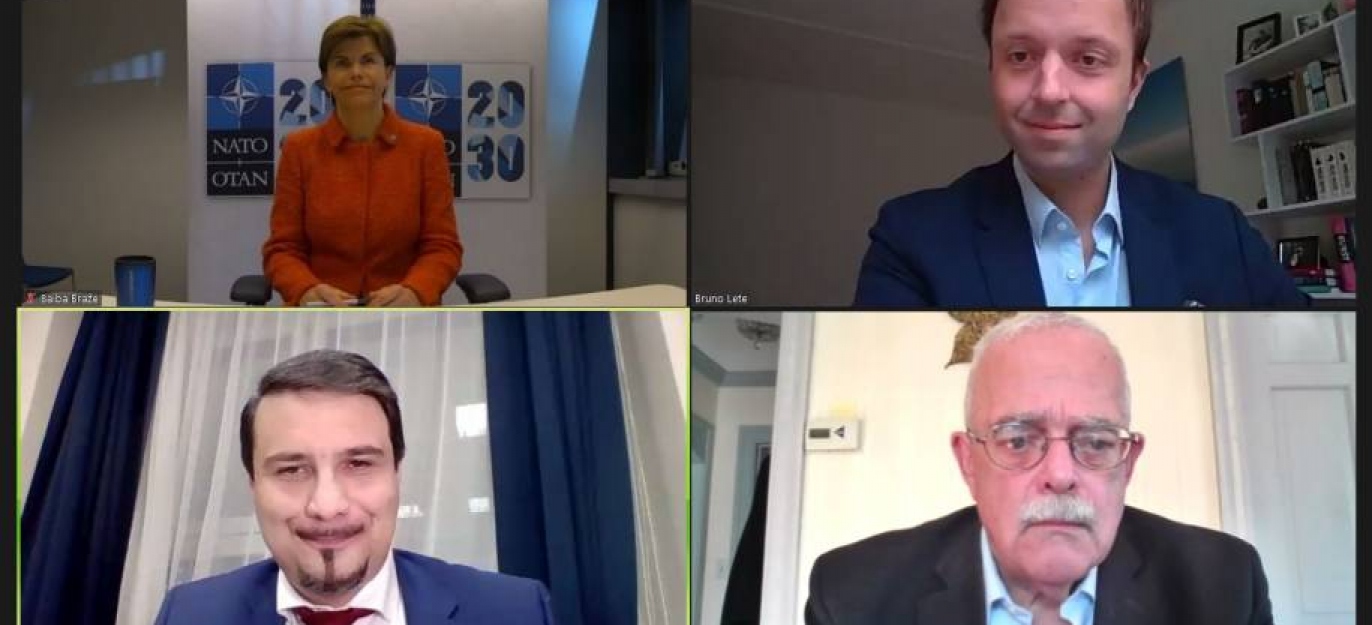
Readying the Alliance for tomorrow’s challenges: NATO PA leaders discuss NATO 2030 with NATO Assistant Secretary General at GMF public event
25 November 2020
The newly elected President of the NATO Parliamentary Assembly, Gerry Connolly (United States), and Vice-President Attila Mesterhazy, who preceded him as President, joined Ambassador Baiba Braze, NATO Assistant Secretary General for Public Diplomacy, for a discussion on NATO 2030: Today’s Alliance Readying for Tomorrow’s Challenges. The event was organised by the German Marshall Fund of the United States (GMF) and moderated by GMF Senior Fellow for Security and Defense Bruno Lété.
The event took place a day after the conclusion of the NATO Parliamentary Assembly’s 2020 Annual Session, where members discussed the future of the Alliance with NATO Secretary General Jens Stoltenberg and adopted the declaration NATO 2030: A More United and Stronger Alliance on the Global Stage.
“NATO is at a critical juncture,” said President Connolly. “The international power distribution has shifted fundamentally, and it is high time for NATO to revise its Strategic Concept to reflect this evolution,” he argued.
The new Strategic Concept must take into account Russia’s ongoing aggressive actions and, importantly, China’s rise. Author of a resolution on A Transatlantic Strategy on China, passed the previous day, President Connolly argued that “China’s unrelenting and rapid rise has threatened to upend the geopolitical landscape of the twenty-first century – not only in China’s neighbourhood, but globally.”
“We must also strengthen the Alliance internally,” he said. “NATO’s success over the past 70 years is not only due to its collective security and military capabilities, but also what fuels us internally: the common values we share. Today, the values upon which the Alliance has been founded are being challenged by external enemies of democracy and by internal proponents of illiberalism.”
Vice-President Mesterhazy chimed in and outlined the vision he laid out in the NATO 2030 declaration. “NATO must strengthen unity, cohesion, and solidarity, adapt to a rapidly evolving security environment, and ensure NATO plays its part in supporting global peace and stability,” he stressed.
He also addressed the impact of the COVID-19 crisis and the Allied response. “One year ago, Allied leaders decided to launch a reflection process on ways to strengthen NATO further,” Vice-President Mesterhazy said. “They did not know then that this process would coincide with the most serious, profound, and wide-ranging crisis which our societies and economies have known in decades.”
“This pandemic has also confirmed that our nations must learn to better confront a number of new dynamics and new challenges,” he went. “COVID-19 is a security issue.”
During her remarks, Ambassador Braze stressed that NATO must continue to tackle traditional threats and challenges, like Russia’s ongoing violations of international law and aggressive actions in Europe.
However, NATO had no choice but to deal with emerging threats and challenges as well: from cyber and hybrid operations to the adverse effects of climate change; from disruptive technologies to potential use of space as a hostile environment; and from challenges to the resilience of Allied societies to a China that does not share liberal democratic values underpinning the Alliance and actions undermining the international rules-based order.
Paris Defence and Strategy Forum (PDSF)
Panel on “Rethinking European and Transatlantic Alliances”
Tuesday 11 March 2025 – 11:30-13.00
École Militaire (Foch Auditorium)
2020 - REPORT - NATO’S ESSENTIAL ROLE IN THE COVID-19 PANDEMIC
Attila MESTERHAZY (Hungary)
The Alliance reacted swiftly and effectively to do its part to mitigate the impact of the spreading coronavirus early in 2020. It continues to contribute to the fight that will lead to its ultimate defeat. To date, NATO has coordinated well over 350 missions to…
2020 - GENERAL REPORT - THE RISE OF CHINA: IMPLICATIONS FOR GLOBAL AND EURO-ATLANTIC SECURITY
Gerald E. CONNOLLY (United States)
The rapid rise of the People’s Republic of China in the last part of the 20th century and early decades of the 21st century represents a paradigm shift in global affairs comparable in magnitude to the collapse of the Soviet Union.
…
2019 - NATO@70: WHY THE ALLIANCE REMAINS INDISPENSABLE
Gerald E. CONNOLLY (United States)
This Sub-Committee report was adopted on Saturday 12 October 2019 by the Political Committee at the 65th Annual Session of the NATO Parliamentary Assembly in London, United Kingdom.
For the past 70 years,…
2018 - NORTH KOREA'S CHALLENGE TO INTERNATIONAL SECURITY - 179 PCTR 18 E fin
Gerald E. CONNOLLY (United States)
This report discusses the challenges posed by the Democratic People’s Republic of Korea (DPRK) - commonly known as North Korea- to regional and international security. It begins with a review of North Korea’s ballistic and nuclear weapons…
2018 - BURDEN SHARING: NEW COMMITMENTS IN A NEW ERA - 170 DSCTC 18 E rev 1 fin
Attila MESTERHAZY (Hungary)
NATO is implementing ambitious new adaptations to its defence and deterrence posture in response to a rapidly evolving international security environment. In parallel there is a rising expectation all NATO Allies must do more to invest in the success of these…
Report of the Sub-Committee on Transatlantic Defence and Security Cooperation [163 DSCTC 17 E rev.1 fin]
Efforts to strengthen the breadth and depth of NATO-EU cooperation have a long, relatively unfruitful…
2017 - NATO AND SECURITY IN THE ARCTIC - CONNOLLY REPORT -172 PCTR 17 E rev1 fin
Report Title: NATO and Security in the Arctic
Rapporteur: Gerald E. CONNOLLY (United States)
Year: 2017
The Arctic region, or High North, ranked top of the security agenda during the Cold War due to its strategic importance. Its significance was…
2010 - THE ASSEMBLY'S CONTRIBUTION TO THE NEW STRATEGIC CONCEPT OF THE ALLIANCE
This document is the product of extensive consultation within the Assembly involving all five of its Committees. Although Assembly members represent very diverse political perspectives, consensus emerged on certain key themes in debates on the new Strategic Concept, including:…