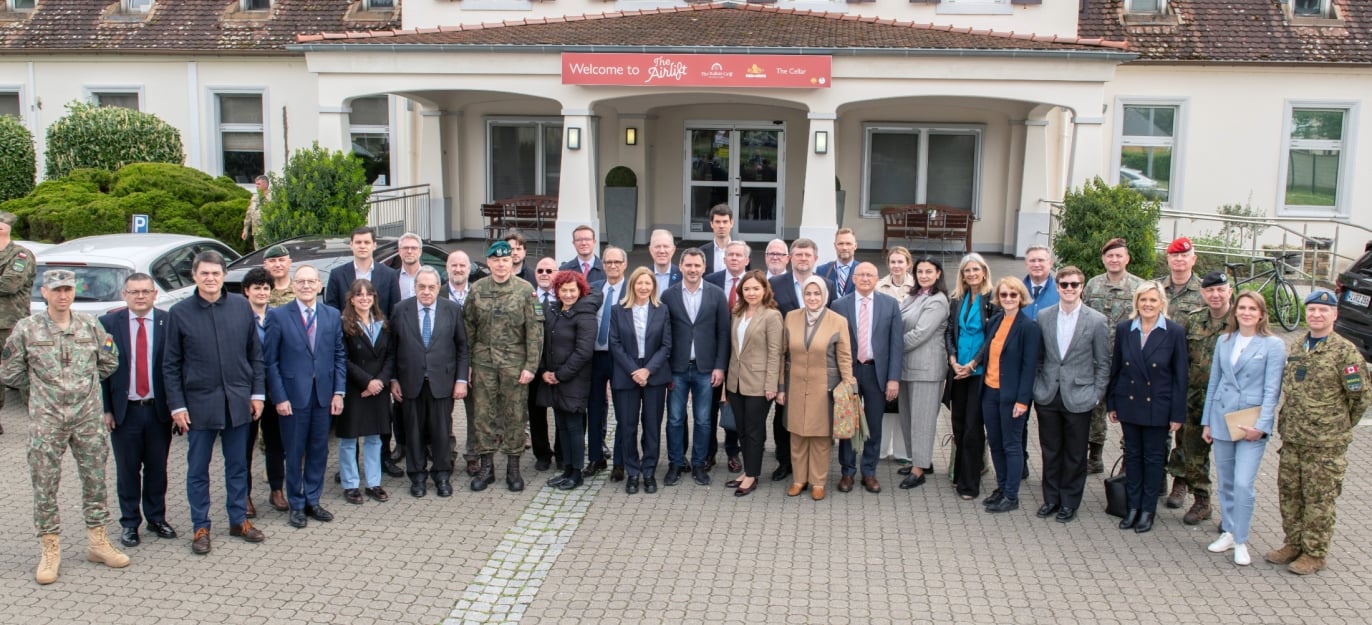
A special meeting of the Ukraine-NATO Interparliamentary Council (UNIC) convened in Wiesbaden from 23-24 April to combine a review of the Assembly’s ongoing political support for Ukraine’s self-defence against Russia’s war of aggression. This event included a visit to NATO’s Security Assistance and Training for Ukraine (NSATU), a new Allied command launched at the 2024 Washington NATO Summit to assist with the delivery of essential Allied and partner security assistance to Ukraine. The delegation attending the UNIC meeting also included officers of the NATO PA Defence and Security Committee (DSC) and the of Sub-Committee on NATO Partnerships (PCNP).
The meeting was overshadowed by the deadliest Russian missile and drone attack on Kyiv since July 2024. The attack added a sharp and sombre note to the challenges of the ongoing renewed peace negotiations. The scale and scope of the attack on civilian infrastructure underlined, yet again, Russia’s desire to continue inflicting arbitrary suffering and violence across the country to cow the Ukrainian people into submission and abandon their valiant fight for freedom. As Ukrainian parliamentarians made clear throughout the meetings, however, Ukraine’s resilience and will to resist and continue fighting remains stronger than ever. This resolve is buoyed by the continued strong external financial and military support of the broad coalition of over 50 Allied and partner nations.
Oleksandr Kornyenko, Co-Chair of UNIC and First Deputy Speaker of the Verkhovna Rada of Ukraine, encapsulated the core message of the participating Ukrainian delegation in the following words: “Ukraine pays the highest price every day for Europe’s security. We are deeply grateful for your support — yet we urge you to act faster and with greater resolve. The only path to lasting peace lies in robust defence, close cooperation with our partners and full NATO membership. We remain open to dialogue, but concrete steps — such as closing the skies, supporting our defence industry and investing in Ukrainian production — are essential to stopping the aggressor and securing peace not only for Ukraine, but for all of Europe.”
UNIC Co-Chair Audronius Azubalis (Lithuania) noted: “We have had Madrid. We have had Vilnius. We have had Washington. Now we need The Hague — not as another declaration, but as a turning point. Pledging EUR 40 billion for Ukraine was a beginning. Now we must go further. Ukraine’s survival cannot depend on quarterly pledges. It needs multi-year certainty.”
Yehor Cherniev, UNIC Rapporteur and Head of the Ukrainian Delegation to the NATO PA, stated: "It would be a huge mistake for NATO countries to try to resume economic cooperation with Russia after the end of hostilities and reduce military support for Ukraine and their own rearmament. Only maintaining economic sanctions can restrain Russia's military recovery and complicate its preparations for new aggression against Europe or Ukraine.”
The delegation’s visit to NSATU was a unique opportunity for Allied legislators to see first-hand how NATO plans, coordinates, and arranges the delivery of battlefield-essential security assistance from Allies and partners to Ukraine to support its self-defence today and to sustain the country over the horizon. NSATU also coordinates the range of training initiatives made available to Ukrainian forces by Allies and exchanges with the European Union Military Assistance Mission. It moreover supports Allied efforts for the longer-term development of Ukraine’s armed forces. NSATU’s efforts serve as the military pillar of enduring support for Ukraine outlined at the Washington Summit – the other two pillars include a pledge of EUR 40 billion in security assistance on a sustainable annual basis and the establishment of a high-level political NATO representative in Kyiv to engage with Ukrainian authorities.
In the first year of the pledge, Allies exceeded their security assistance by delivering over EUR 50 billion. The 27th meeting of the Ukraine Defence Contact Group (UDCG) met just two weeks before the delegation’s visit to NSATU. At the meeting of 51 Allied and partner nations, EUR 21 billion in new security assistance was pledged to Ukraine.
Briefers at NSATU confirmed that Allies stand behind Ukraine and will continue to do so, not as parties to the conflict, but as strategic enablers of Ukraine’s legitimate self-defence, as enshrined in the UN Charter. Since its inception, NSATU has streamlined its operations, making them more efficient, integrated and synchronised with Ukrainian forces to deliver, as one briefer noted, “enduring, predictable, and coherent support to Ukraine through the coordination of Allied equipment donations, logistics, training, and planning efforts with a 24-month horizon.”
Noting his strong impressions from the visit to NSATU, Audronius Azubalis stated emphatically: “NSATU is not a warehouse. It is NATO in action. It is NATO evolving.”
“This NATO command must become a symbol of permanence, of shared burden, and of strategic maturity,” he continued. He stressed that NSATU “must become not only a channel of support, but also a bridge into the Alliance, with standards, interoperability, and readiness built in.” Delegation members reiterated throughout the meeting the need for Ukraine’s NATO membership.
Over the course of the visit, official interlocutors, invited experts, and members all stressed the imperative of increasing defence budgets and military production which all Allies are now facing, particularly across Europe. A recurring theme stressed by participants was the urgent need to rebalance responsibilities within NATO, with European Allies taking more responsibility for deterrence and defence at home. Delegation members made it clear that the will to implement this burden shift is strong.
Germany, the host nation of several NATO commands and significant numbers of U.S. and Allied forces working to ensure Allied deterrence and defence, is a leader of the new burden-shifting efforts. Not long after the shock of Russia’s full-scale invasion of Ukraine in 2022, the nation announced a zeitenwende, or a turning point, in its approach to deterrence and defence policies at home and within the Alliance. This resulted in an immediate one-off EUR 100 billion fund for defence in 2022, and last month’s exemption of defence spending above 1% of GDP from the “debt brake”, anchored in the Constitution and limiting government borrowing.
Throughout the visit, however, participants continued to stress that transatlantic unity is vital to the defence of the free world. As one delegate noted succinctly: “Europe needs the United States, and the United States needs Europe.” This important message will only resound more clearly at the upcoming NATO PA Spring Session in Dayton, Ohio, from 23-26 May.
The Assembly, though institutionally separate from NATO, serves as an essential link between NATO and the parliaments of the NATO nations. It provides greater transparency of NATO policies and fosters better understanding of the Alliance’s objectives and missions among legislators and citizens of the Alliance. The UNIC was created in 1998 to bring greater transparency to the implementation of the NATO-Ukraine Charter and to demonstrate parliamentary interest and involvement in cooperation between NATO and Ukraine. It has since become a wider forum where members can discuss any issues of mutual concern. The UNIC has played a leading role in the Assembly’s response to Russia’s renewed invasion.
Photos of the visit to Wiesbaden, courtesy of ©NSATU, © Kloster Eberbach, ©NATO Parliamentary Assembly